


Evidence-informed policymaking (EIPM) is increasingly recognised as essential to developing effective, accountable and forward-looking public policies. However, despite the growing availability of scientific knowledge, data and evaluation results, ensuring that evidence informs policy decisions remains a persistent challenge. The question is not simply how to produce more evidence, but how to make it accessible, relevant and meaningful to those shaping public policy — and how to build the institutional capacity to use it in changing and uncertain contexts.
At EFIS Centre, we are working on this stream of work, exploring how knowledge can better inform policymaking, how research can support public institutions in navigating complex transitions, and how evidence can be translated into tangible policy impact. Building on our experience in science-for-policy (S4P) initiatives, knowledge valorisation and evidence-informed policymaking, we are particularly interested in the conditions that enable knowledge to travel across institutional, disciplinary and geographical boundaries.
Connecting science, policy and practice across Europe
EFIS Centre’s work in this area builds on several recent complementary experiences. Through the Policy Support Facility (PSF) Mutual Learning Exercise (MLE) on Bridging the Gap between Science and Policy, we contributed to exchanges on how European countries can strengthen the connections between research and policymaking. This work highlighted the importance of institutional arrangements, intermediary roles and sustained collaboration in enabling scientific knowledge to inform policy processes.
EFIS Centre is currently an active partner in S4PXchange: Integrating Communities and Practices for a Robust, Inclusive, and Sustainable European Science-for-Policy Ecosystem – a Horizon Europe project running from June 2026 until May 2029. Our team, led by Elina Griniece, will be leading the analysis of the project’s impact and legacy, examining how its activities and outputs can contribute to more sustained capacities for science-for-policy engagement. Furthermore, EFIS team will support various project activities such as refining S4P conceptual approach, facilitating and animating community building activities, organising Policy Dialogues and improving S4P skills and capacities through structured learning activities.
We also have an active role in the Knowledge Valorisation community, particularly our work on strengthening the uptake of knowledge in policymaking, stream of work led by Matías Barberis. Knowledge valorisation contribution to public policy is important: adding value to existing knowledge can inform the design of public interventions, improve implementation, support evaluation and help institutions anticipate and respond to societal challenges. Valorising knowledge requires considering policy uptake from the outset of research and innovation activities, identifying the actors who can facilitate it, and developing appropriate mechanisms to translate findings into practical use.
Learning from experience
On 7 October 2026, EFIS Centre participated in the second in-person meeting of the Evidence-Informed Policymaking (EIPM) Community of Practice, jointly led by the European Commission’s Joint Research Centre (JRC) and DG Research and Innovation. The event gathered representatives from EU member states, European Commission DG RTD, as well as researchers in the field of EIPM in engaging discussions. The meeting focused on six core topics: determining the minimum evidence needed to move quickly from problem identification to policy action, particularly in rapidly evolving fields such as emerging technologies; integrating long-term thinking into policymaking, using future-oriented reference points to inform present decisions; the practical benefits of institutionalising evidence-informed policymaking; identifying the enabling factors that to translate evidence into policy impact; and notably exchanging international good practices.
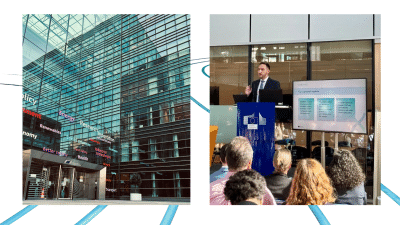
Discussions highlighted that evidence use is not a linear process: producing research and making it available does not guarantee that it will inform policy decisions or public debate. Evidence is interpreted and contested in political and institutional contexts, and more information does not necessarily translate into better-informed decisions. A key takeaway was the need to look beyond the production and communication of evidence to how it is used in practice. Reports and repositories are not enough on their own; effective uptake requires an effective dialogue between researchers, policymakers and intermediaries, alongside opportunities to test policy approaches, evaluate results and learn from implementation.
The discussions also highlighted the importance of strengthening institutional capacities to use evidence in changing circumstances. This means moving beyond the ability to absorb research towards the capacity to critically assess, adapt and apply knowledge as policy challenges evolve. Mandates, dedicated resources, incentives for evidence use, programme evaluation and transparency about the evidence underpinning decisions are important conditions for making evidence-informed policymaking part of routine practice.
What’s next?
Achieving wider policy impact also requires recognising that complex societal challenges call for evidence that bridges disciplines and connects scientific knowledge with the experience of policymakers, practitioners and communities. Interdisciplinary and transdisciplinary approaches can help bring these perspectives together, making evidence more relevant to policy needs and supporting solutions that are responsive to different contexts.
In this context, the challenge ahead is not simply to make available more evidence, but to build the conditions under which evidence can inform decisions, support public debate and enable institutions to learn and adapt. Strengthening those conditions — through sustained collaboration, transnational learning, institutional commitment and effective knowledge valorisation — is essential to making research more consequential for public policy across Europe.

